
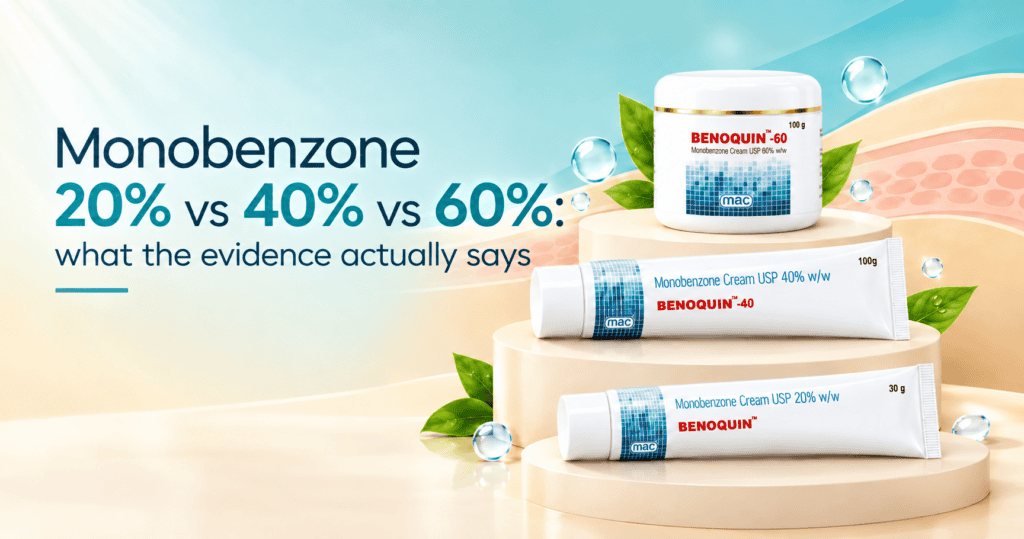
Search for monobenzone cream online and you’ll find the same product sold at 20%, 40%, 60% and sometimes 80%. It’s natural to assume a higher number means faster or better results.
With this ingredient, that assumption is risky. Monobenzone removes pigment cells, and the effect is generally permanent, which makes it a different animal from creams that fade skin for a while. So the strength you choose matters a lot.
Here’s what monobenzone is for, what’s known about monobenzone 20% vs 40% (and 60%), and what to think about if you’re in Dubai or elsewhere in the UAE.
Quick answer: which monobenzone strength is supported by evidence?
- 20% is the standard strength, and the one with published clinical use.
- 40% is sometimes prepared by compounding pharmacies for resistant areas. A doctor makes that call.
- 60% and above has no established place in dermatology guidelines that we could find.
What monobenzone does, and who it's for
Monobenzone is the monobenzyl ether of hydroquinone. It’s indicated only for the final depigmentation of disfiguring vitiligo. You apply it to the normal skin around vitiligo patches, in people with disseminated vitiligo (more than 50% of body surface area).
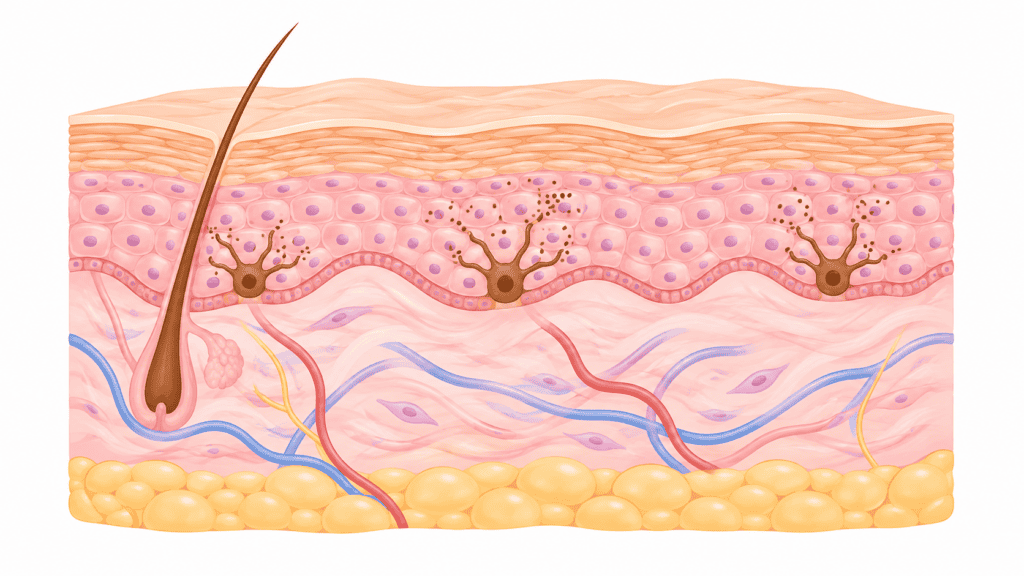
In plain terms: say someone has vitiligo across most of their body, and the remaining pigmented skin creates a strong contrast. A dermatologist may suggest removing that leftover pigment so the tone evens out.
Monobenzone isn’t a treatment for:
- melasma
- sun spots or freckles
- acne marks
- tanning
- general skin whitening
It’s not recommended for skin conditions other than vitiligo. If your goal is fading dark marks, this is the wrong ingredient at any strength.
That narrows the strength question to a small group of people. They should be making the decision with a doctor.
Monobenzone 20%: the strength with the evidence
When it comes to monobenzone 20% vs 40%, most of the clinical experience is with the 20% cream. You’ll see it labelled as monobenzone cream USP 20, Benoquin 20 cream or Uniqueen 20%. The brand tells you who made it, and the percentage tells you the dose.
What the sources report:
- Depigmentation is usually achieved after 6 to 12 months with 20% monobenzone, after which the cream is used only as often as needed to maintain the result.
- In one clinical study of patients with severe vitiligo, 20% monobenzone produced depigmentation in 84% of patients, with complete depigmentation in 44%.
- Some dermatologists ease in gradually. One patient resource describes starting at 10% for 1 month, then moving to 20%, and testing on a small area for 3 to 4 months before treating other areas.
Notice that timing and frequency vary between sources. One reference describes application 2 or 3 times daily. Another describes once or twice daily, 3 or 4 days a week. So there’s no single fixed routine, and your dermatologist’s instructions carry more weight than any label.
Monobenzone 40%: when doctors consider it
Benoquin 40 and similar 40% creams are widely sold, but 40% is less standard than sellers make it sound.
Dermatology guidance summarised on our own Uniqueen product page says monobenzone is commonly found in 20% form, with up to 40% compounded by pharmacies for resistant areas. A US compounding pharmacy also describes it as a 20-40% topical preparation.
So think of 40% as a specialist option for patches that haven’t responded to 20%.
You’ll also see claims that 40% works “in 4 to 8 weeks.” Those come from seller blogs. We could not find a published trial comparing monobenzone 20% vs 40% head to head. So we can’t tell you 40% is faster, and we can’t tell you it’s safe for you.
What about 60% (and higher)?
This is where the evidence runs out.
Our own Uniqueen 60% page states that an official 60% form could not be found in dermatology guidelines. That means there’s no established guidance on how long to use it, how to apply it, or how to manage side effects at that concentration.
If a doctor picks a higher strength, that’s a judgment about one person’s skin. The general literature doesn’t back it. If your doctor does recommend it, you can check the pack details on our Benoquin 60% cream page.
Monobenzone 20% vs 40% vs 60% at a glance
20% | 40% | 60% | |
Standing in guidelines | Standard strength | Compounded in some resistant cases | No official form found |
Published clinical data | Yes (see above) | Limited | None found |
Who it’s for | Extensive vitiligo, under supervision | Areas not responding to 20% | Individual specialist judgment only |
Main caution | Slow, permanent | Higher irritation risk | Unknown risk profile |
This table only shows what we could verify. “None found” means we didn’t find it, and we can’t rule out that it exists.
Why a higher strength isn't automatically better
- The result is unpredictable. The depigmenting effect is described as erratic, and it may take 1 to 4 months to appear. A stronger cream doesn’t remove that variability.
- Side effects increase with dose. Side effects are generally dose-dependent. They can include rash, dry skin and premature hair graying, and treated skin may stay permanently sensitive to sunlight.
- Depigmentation can spread. Monobenzone can cause depigmentation at sites away from where you applied it. That’s a bigger concern the stronger the cream.
- It can affect other people. Reports describe “consort vitiligo,” where vitiligo shows up in people living with someone who uses monobenzone. Avoid contact with them for at least 3 hours after application. If you share a home with a partner or children, this matters.
- It can’t be undone. Hydroquinone lightens skin temporarily. Monobenzone destroys melanocytes, and once that happens, going back isn’t possible.
Choosing a strength in Dubai and the UAE
Some practical points for readers here:
Start with a dermatologist before you open a product page. A doctor can confirm whether you have extensive vitiligo, whether depigmentation makes sense, and which strength to start with. In the US, a prescription is required for monobenzone. UAE requirements are set by local health authorities, so check the current rules with a licensed doctor or pharmacist before ordering.

Take the sun seriously. The UAE gets strong sun most of the year. Depigmented skin has lost its natural protection, and treated skin can stay permanently sensitive. Daily broad-spectrum sunscreen, shade and covering clothing become long-term habits that never really stop.
Read the label carefully. Check the percentage (w/w), pack size, manufacturer, batch number and expiry date. Compare the percentage across brands and ignore the brand name. Our guide to Uniqueen vs Benoquin: what’s the difference for vitiligo explains how the two brands compare.
Ask about a small-area trial. As noted above, some dermatologists begin on a limited area before treating more of the body.
Plan for the household. Wash your hands after applying, and avoid skin contact with others for several hours afterward.
Common mistakes
- Choosing 40% or 60% because it sounds faster
- Using monobenzone for dark spots or melasma
- Applying more than instructed, hoping to speed things up
- Skipping sunscreen once the skin has lightened
- Assuming all monobenzone creams with the same percentage are identical
- Starting treatment without knowing the result is permanent
Conclusion
e honest summary is short:
- Monobenzone is for extensive vitiligo only, and the effect is permanent.
- 20% has the clinical evidence behind it.
- 40% is a specialist option.
- 60% and above lacks guideline support that we could find.
- A stronger cream brings more irritation risk and doesn’t guarantee a better result.
If you’re weighing monobenzone 20% vs 40%, talk to a licensed dermatologist first. Then compare products on percentage and manufacturer, and let the brand name come last. Have questions about a specific product before you decide?