
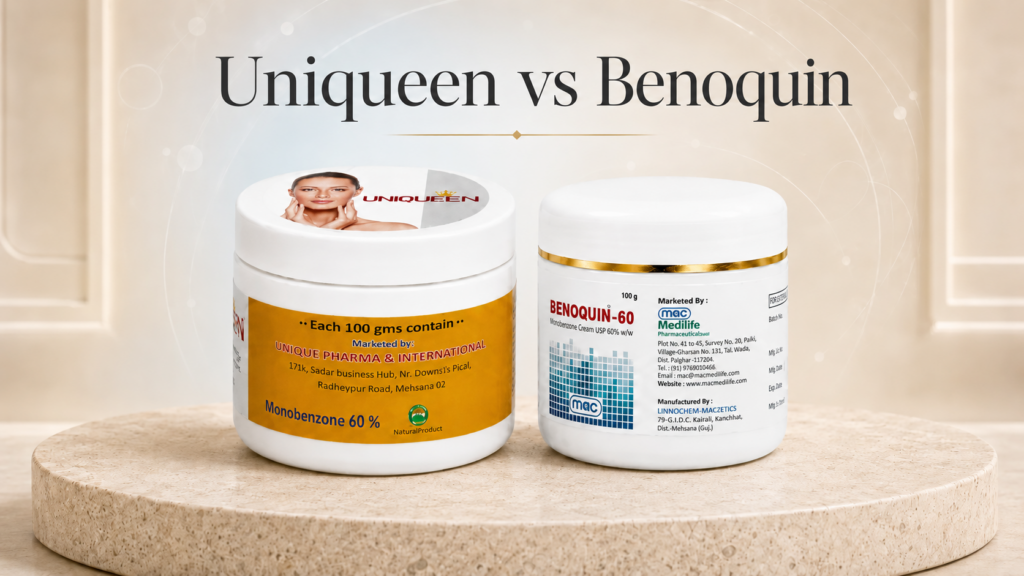
If you’ve been researching vitiligo depigmentation treatment in Dubai or the UAE, you’ve probably seen both “Uniqueen” and “Benoquin” listed by the same suppliers, sometimes even on the same product page. It’s reasonable to wonder whether they’re different medications or the same treatment sold under different names. You may also notice differences in price, strength, or packaging between listings.
Here’s the short answer, followed by the details.
The Short Answer: Same Active Ingredient, Different Brand Names
Uniqueen and Benoquin are both brand names for monobenzone (monobenzyl ether of hydroquinone, sometimes abbreviated MBEH). They contain the same active pharmaceutical ingredient, but they’re manufactured and packaged under separate brand identities.
Benoquin is the original, internationally recognised brand name for topical monobenzone. Uniqueen is another manufacturer’s brand of the same compound, produced in a similar range of concentrations.
The percentage of monobenzone in the formula determines the product’s strength and plays a major role in how a dermatologist plans treatment. Depending on the product range, concentrations typically include 20%, 40%, 60%, or 80%.
So when comparing Uniqueen vs Benoquin, you’re looking at 2 brands of monobenzone. Concentration is a separate choice and should match the strength your dermatologist has recommended.
What Monobenzone Actually Does
Monobenzone is a topical depigmenting agent used specifically for extensive, widespread vitiligo. It isn’t intended for melasma, freckles, sun spots, acne marks, or general cosmetic skin lightening.
According to DermNet’s overview of vitiligo, vitiligo is a chronic depigmenting skin disorder in which pigment-producing melanocytes are progressively lost.
Monobenzone works by triggering the selective destruction of melanocytes, the cells that produce melanin (skin pigment), in areas where it’s applied.
Unlike temporary skin lighteners, monobenzone produces an effect considered permanent and irreversible. Once melanocytes in a treated area are destroyed, the skin doesn’t regain its natural pigment.
That permanent effect explains its specific clinical role. For patients whose vitiligo covers a large percentage of the body, monobenzone can depigment the remaining naturally pigmented skin so its appearance becomes more consistent with areas already affected by vitiligo.
DermNet’s guidance on depigmentation therapy for vitiligo identifies monobenzyl ether of hydroquinone (MBEH), also called monobenzone, as the most commonly used depigmenting agent for extensive vitiligo. It has historically been available as a 20% cream, while higher concentrations may be used for more difficult areas.
Clinical research into different monobenzone concentrations has examined how strength affects effectiveness and skin tolerance. Concentration is therefore one of the main clinical factors a dermatologist considers when planning treatment.
Because the effect is permanent, monobenzone should only be used under dermatologist supervision. Treatment also requires realistic expectations about timing, since visible results usually develop gradually over several months.
Benoquin: Brand Background and Strengths
Benoquin is the best-known brand name historically associated with monobenzone cream. It’s commonly referenced in older clinical literature and patient resources, which is one reason many patients search for Benoquin first.
Patients researching higher-strength formulations can read our detailed guide to Benoquin Monobenzone Cream 60% in Dubai and UAE for more information about this concentration and its use in vitiligo depigmentation treatment.
In some Western markets, including the US, availability of products sold under the Benoquin brand name has changed over time. Monobenzone itself continues to be used as a depigmentation treatment for selected cases of extensive vitiligo under medical guidance.
Uniqueen: Brand Background and Strengths
Uniqueen is a separate skincare and pharmaceutical brand that produces monobenzone cream as its main depigmentation product. Its range also includes complementary products such as monobenzone-based soap and skin-lightening lotions.
The Uniqueen monobenzone range comes in multiple concentrations for different stages of vitiligo treatment:
- Uniqueen Monobenzone Cream 20%: the standard, entry-strength formulation
- Uniqueen Monobenzone Cream 40%: used for more extensive vitiligo or for patients progressing from 20%
- Uniqueen Monobenzone Cream 60%: a higher-strength option for widespread cases under closer supervision
- Uniqueen Monobenzone Cream 80%: the strongest formulation in the range, reserved for carefully selected extensive cases
For a closer look at one of the mid-range concentrations, see our guide to Uniqueen Monobenzone 40% depigmentation cream for extensive vitiligo.
Uniqueen also produces a monobenzone-based soap. Some patients use this format on larger body areas such as the back, chest, or limbs because a wash-off product can be easier to spread evenly across wide areas than a spot-applied cream.
Uniqueen vs Benoquin: Side-by-Side
The Uniqueen vs Benoquin comparison becomes clearer when you look at the active ingredient, available strengths, formats, and intended use side by side.
| Benoquin | Uniqueen |
Active ingredient | Monobenzone | Monobenzone |
Mechanism | Selective melanocyte destruction | Selective melanocyte destruction |
Effect | Permanent, irreversible depigmentation | Permanent, irreversible depigmentation |
Available strengths | Varies by supplier | 20%, 40%, 60%, 80% |
Formats | Cream | Cream, soap, complementary lotions |
Indicated use | Extensive/widespread vitiligo, under medical supervision | Extensive/widespread vitiligo, under medical supervision |
Not indicated for | Melasma, freckles, sun spots, cosmetic lightening | Melasma, freckles, sun spots, cosmetic lightening |
Your dermatologist’s recommended concentration and the size of the treatment area should guide the decision. Products from different brands containing the same percentage of monobenzone are intended to deliver the same active ingredient. Changing the percentage changes the strength, even when the brand stays the same.
How to Choose Between Them
When considering Uniqueen vs Benoquin, a few practical factors can help you choose:
- Follow your dermatologist’s concentration recommendation first. Vitiligo coverage, skin sensitivity, and your previous treatment history affect which strength is appropriate. The prescribed concentration matters more than the brand name.
- Start conservatively if you’re new to monobenzone. Many patients begin with a lower concentration and move to a higher strength only when their dermatologist recommends it after seeing how their skin responds and tolerates treatment.
- Consider the format for the area being treated. Cream works well for localized or moderate-area application. A soap format, currently available in the Uniqueen range, may be practical for patients treating larger or harder-to-reach areas.
- Buy from a supplier that clearly states the exact concentration. Monobenzone causes permanent depigmentation, so knowing the precise strength matters. Avoid listings that leave the concentration unclear.
Safety Notes That Apply to Both Brands
Regardless of where you land in the Uniqueen vs Benoquin comparison, the main monobenzone precautions stay the same:
- Apply it only to areas specified by your dermatologist. Don’t use monobenzone as a general cosmetic lightener on normally pigmented skin outside your treatment plan.
- Wash your hands thoroughly after application so you don’t accidentally transfer the cream to untreated skin.
- Keep monobenzone away from the eyes, lips, open wounds, and irritated skin.
- Depigmented skin loses natural UV protection. Daily broad-spectrum SPF 50+ is essential on treated areas and should continue indefinitely.
- Stop using the product and seek medical advice if you develop severe burning, swelling, blistering, or a persistent rash.
- Visible results usually take months, and full depigmentation can take considerably longer. Monobenzone treatment requires time.
DermNet’s medical guidance also stresses the permanent nature of depigmentation treatment, the need for long-term sun protection, and the possibility of irritation and contact dermatitis. You can read its full monobenzone safety and depigmentation guidance before discussing treatment with your dermatologist.
Where to Buy Genuine Uniqueen and Benoquin Products in Dubai & UAE
Both brands are available through our Uniqueen monobenzone range and Benoquin monobenzone range. Each product page clearly lists the concentration, making it easier for you and your dermatologist to match the strength with your treatment plan.
If you’re still deciding between Uniqueen vs Benoquin, speak with your dermatologist first. The appropriate choice depends on how much of your skin is affected, the concentration being considered, and how your skin has responded to treatment so far.
This article is for educational purposes and does not replace professional medical advice. Monobenzone is a potent, permanently depigmenting treatment intended specifically for extensive vitiligo under dermatologist supervision. It should not be used as a cosmetic skin-lightening product.