
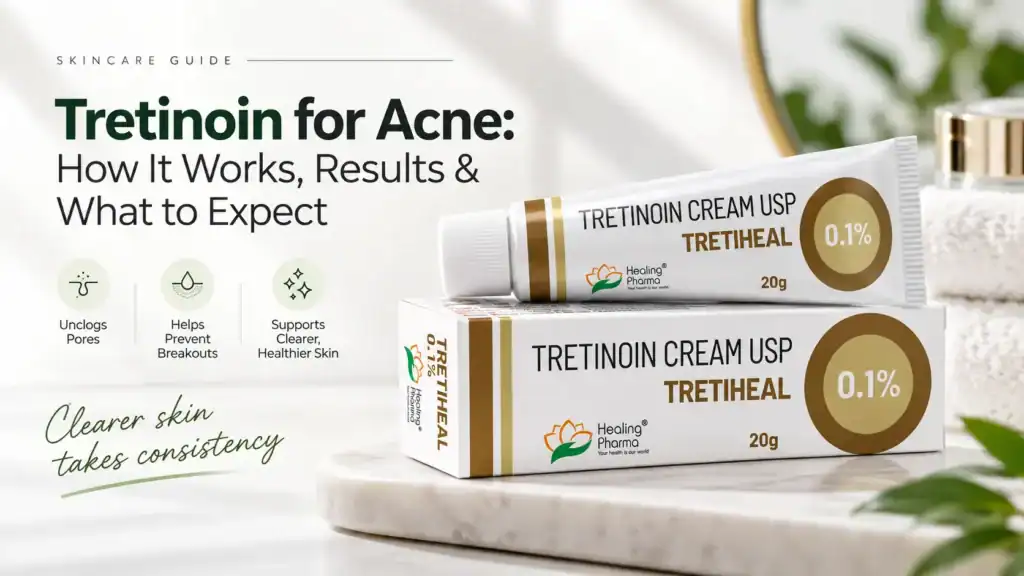
Dealing with breakouts that won’t quit? You’ve probably come across tretinoin already. It’s one of the most studied acne treatments in dermatology. And there’s a reason for that: it doesn’t sit on top of the skin like most acne products. It works inside the pore, which is where acne actually starts.
Tretinoin isn’t a quick fix. It’s not always comfortable in the first few weeks either. Go in without knowing what to expect, and it’s easy to quit right before it starts working.
Here’s how tretinoin for acne actually works, what a realistic before-and-after timeline looks like, the mistakes that slow down results, and what you need to know before starting it. Including this: tretinoin is a prescription-only medication in the UAE. You can’t pick it up over the counter. If you’re new to the ingredient altogether, our complete beginner’s guide to tretinoin in Dubai is a good place to start before diving into acne specifics.
What Is Tretinoin and Why Is It Used for Acne?
Tretinoin is a topical retinoid, a vitamin A derivative that speeds up skin cell turnover. Dermatologists developed it in the 1960s and 70s as an acne treatment. The anti-aging effects came later, as a side benefit.
Cleansers, spot treatments, and salicylic acid products work on the skin’s surface. Tretinoin changes how skin cells behave at a deeper level. That’s why it can hit several types of acne at once: blackheads, whiteheads, and inflammatory breakouts. The American Academy of Dermatology lists topical retinoids like tretinoin among the core treatments dermatologists recommend for clearing pores and calming breakouts.
You’ll usually find tretinoin in strengths of 0.025%, 0.05%, and 0.1%, as a cream or gel. A higher strength doesn’t mean faster results. It usually just means more irritation, especially if you’re new to it.
How Does Tretinoin Work for Acne?
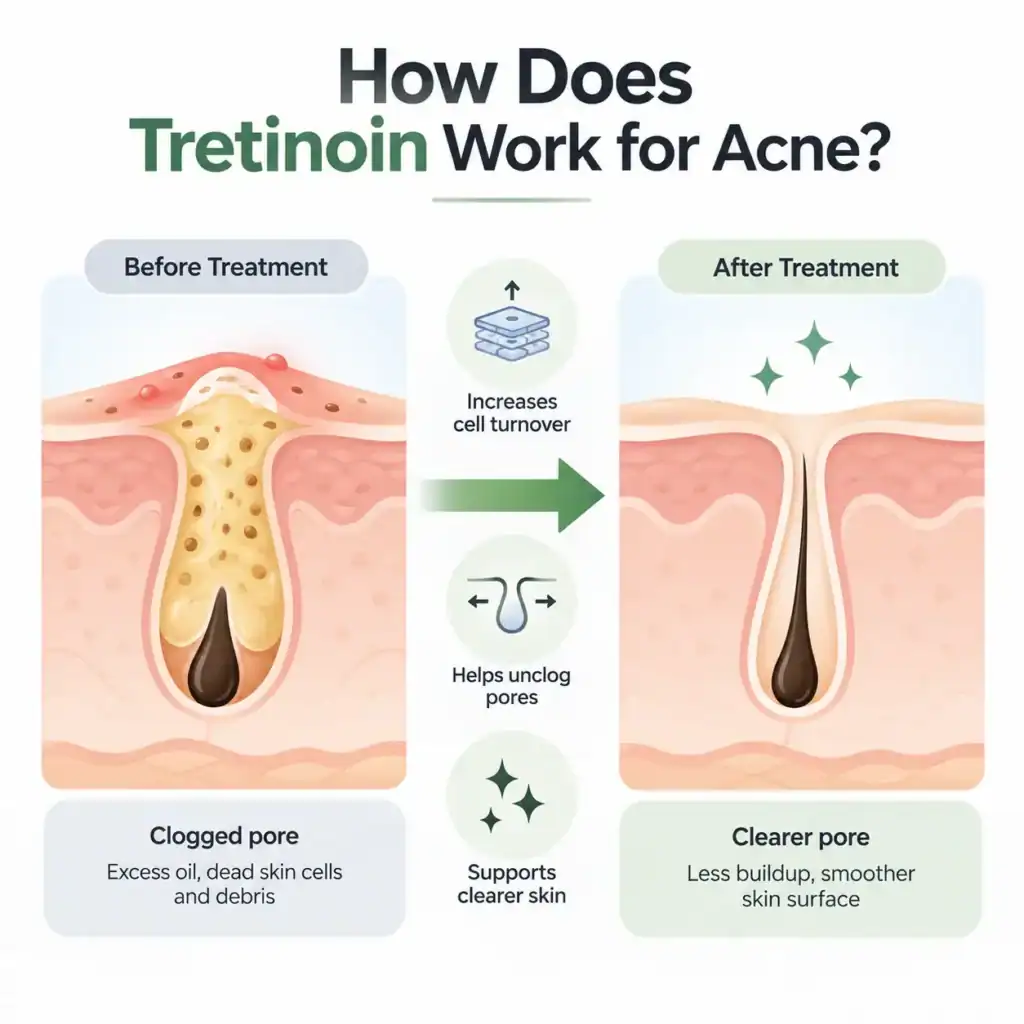
Tretinoin speeds up cell turnover, unclogs pores, and calms the inflammation behind breakouts.
Here’s the process in more detail:
- It prevents clogged pores. Acne starts when dead skin cells stick together inside a pore instead of shedding normally, mixing with oil and bacteria. Tretinoin clears dead cells out before they can clog the follicle.
- It reduces microcomedones. These are the invisible, early-stage plugs that turn into visible pimples. Tretinoin targets this stage, which is part of why it can stop breakouts before they even form.
- It calms inflammation. Tretinoin has a mild anti-inflammatory effect, which helps with the redness and swelling that come with active breakouts.
- It helps other acne treatments absorb better. It thins the outer dead skin layer, so ingredients like benzoyl peroxide can penetrate more effectively. (Though you shouldn’t always apply the two at the same time, more on that below.)
That’s why tretinoin works as a foundational treatment rather than a spot treatment. It works on the skin as a whole, not just on individual pimples. A recent dermatology review on topical tretinoin backs this up, pointing to well-established clinical evidence for its role in treating acne through these combined mechanisms.
How Long Does Tretinoin Take to Work for Acne?
This is where most people get discouraged too early.
Timeframe | What Usually Happens |
Weeks 1–2 | Skin often looks worse before it improves — dryness, redness, flaking |
Weeks 3–6 | The “purge” phase; existing microcomedones surface as breakouts |
Weeks 8–12 | Visible improvement begins; fewer new breakouts forming |
Months 3–6 | Clearer, more even skin texture; results become more consistent |
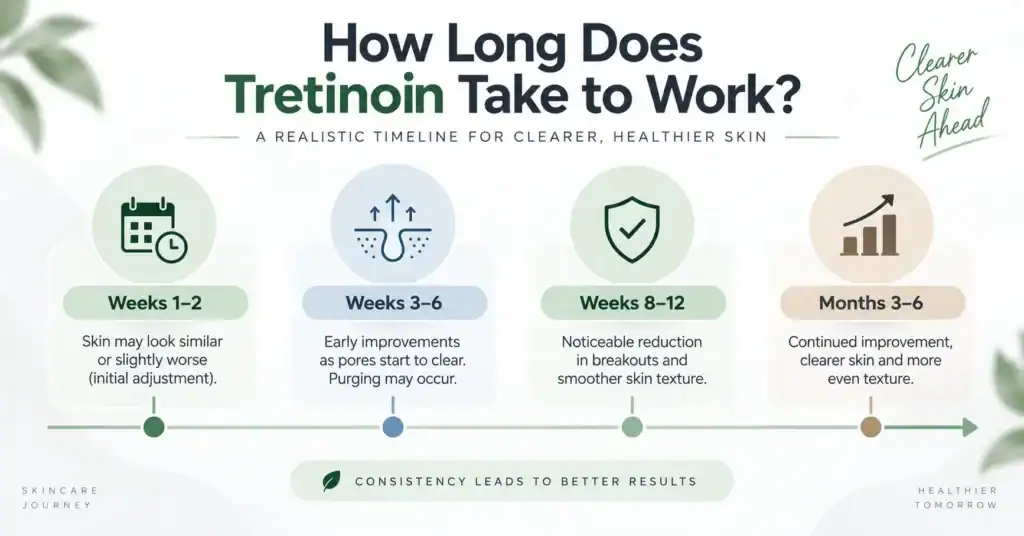
Most dermatological sources agree on 8 to 12 weeks of consistent use for meaningful improvement, with fuller results by month 3 to 6. Tretinoin is changing how your skin renews itself, and that takes several skin cycles. It’s not fast.
The purge phase trips up a lot of first-time users. Tretinoin speeds up turnover, so it brings existing clogged material to the surface faster than usual. That causes a temporary flare-up before things improve. The tell: purging happens in areas you already tend to break out, and it settles within a few weeks instead of getting worse.
Tretinoin for Acne: Before and After — What Realistic Results Look Like
Search “tretinoin for acne before and after” and you’ll find dramatic transformation photos. They’re real, but they rarely show the full timeline or the adjustment period behind them.
A more realistic picture of what tretinoin can do over time:
- Fewer new whiteheads and blackheads forming
- Smaller, less frequent breakouts rather than total elimination
- Smoother texture as dead skin builds up less
- Reduced appearance of enlarged pores over time
- Fading of post-acne marks (this takes longer than active breakout improvement). If dark marks are your main concern rather than active breakouts, our guide to Aziderm 20% for dark spots and hyperpigmentation covers a treatment built specifically for that.
What it typically won’t do: clear severe cystic or nodular acne on its own (that usually needs a dermatologist-guided combination approach), produce results in days, or work well if you use it inconsistently. Skip several nights a week and progress slows down fast.
If your acne is moderate to severe, tretinoin is often prescribed alongside other treatments. Talk to a dermatologist about this rather than guessing on your own.
How to Use Tretinoin Cream for Acne (Without Wrecking Your Skin Barrier)
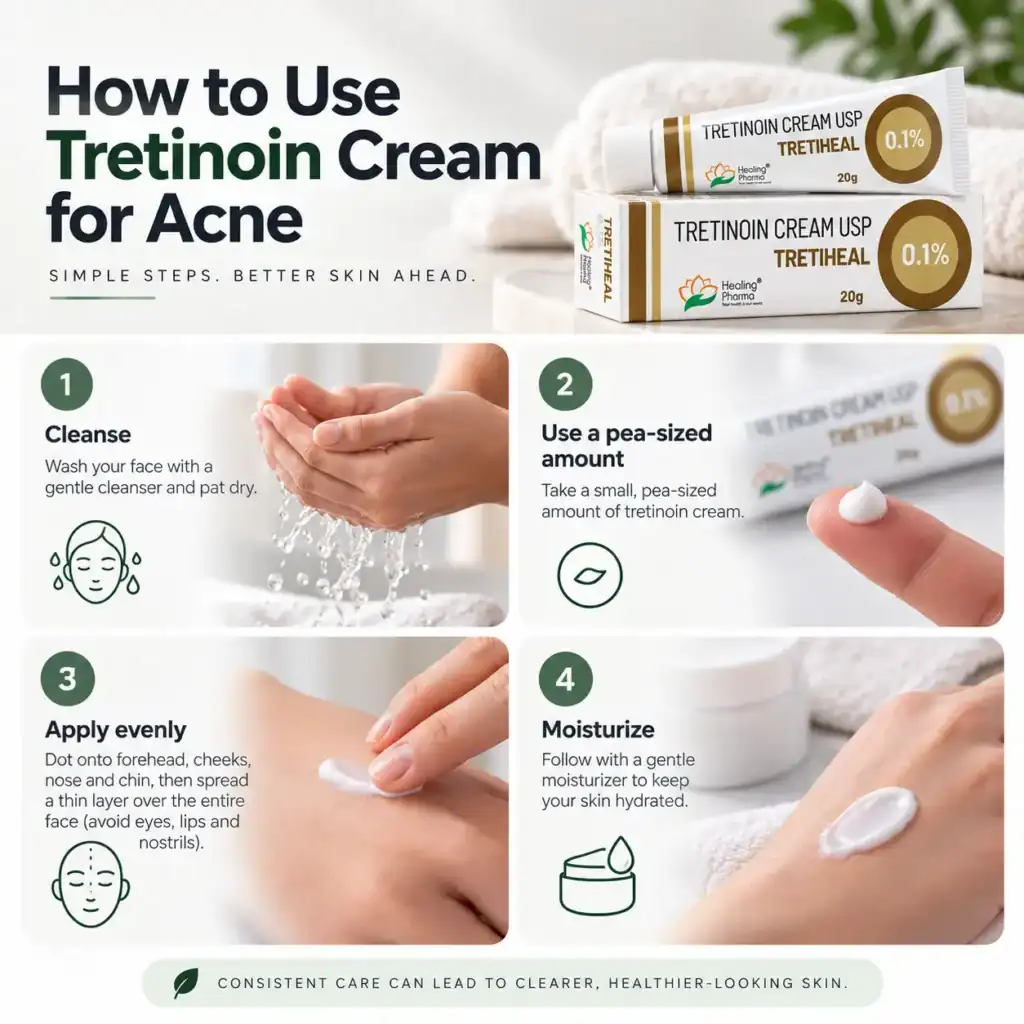
The biggest reason people quit tretinoin? They start too aggressively and wreck their skin barrier in the process. Here’s how to avoid that.
Start slow. A pea-sized amount for the entire face, 2–3 nights a week for the first 2 weeks. Increase frequency gradually as your skin adjusts.
Apply to dry skin. Wait 20–30 minutes after washing your face. Damp skin absorbs tretinoin faster, and that sounds good, but it actually increases irritation. Mayo Clinic’s guidance on proper use backs this up, recommending fully dry skin before application to avoid unnecessary irritation.
Moisturize before or after. Some people apply moisturizer first, wait, then apply tretinoin on top. This “buffering” method cuts irritation without cutting effectiveness much. Others moisturize after. Both work. Consistency matters more than the order.
Use sunscreen every single day. Tretinoin increases sun sensitivity. Skip SPF and you’re not just risking sunburn, you can undo your progress by triggering pigmentation. That matters even more given how strong UV exposure is in the UAE for most of the year.
Avoid combining with harsh actives early on. Strong exfoliating acids (AHAs/BHAs), benzoyl peroxide, and other retinoids alongside tretinoin can overwhelm your skin barrier, especially in the first 2–3 months. Introduce these one at a time, ideally with guidance from a dermatologist or pharmacist.
Common Mistakes That Slow Down Tretinoin Results
- Applying too much product. More cream doesn’t speed things up. It just means more peeling and irritation.
- Quitting during the purge phase. That’s exactly when results are starting to happen beneath the surface.
- Skipping moisturizer. A compromised skin barrier makes acne worse.
- Inconsistent use. Tretinoin depends on steady, ongoing use. Stop and start, and you reset your progress.
- Not adjusting strength or frequency over time. What worked at week 2 might need tweaking by month 3, once your skin builds tolerance.
- Ignoring sun protection. This is one of the most common reasons people see uneven results or new pigmentation.
Is Tretinoin Available Without a Prescription in the UAE?

No. Tretinoin is a prescription-only medication in the UAE, no matter the strength or formulation. You can’t buy it over the counter. Unregulated or unlicensed online sellers carry real risks: counterfeit products, wrong concentrations, and zero medical guidance on how to use it safely for your skin.
Thinking about tretinoin for acne? Start with a consultation with a licensed dermatologist or pharmacy. They’ll assess your skin and confirm the right strength, usage frequency, and whether tretinoin fits with anything else you’re using. Our beginner’s guide to tretinoin in Dubai also walks through what the prescription process typically looks like locally.
Key Takeaways
Tretinoin for acne is one of the most effective long-term treatments out there, but it rewards patience over speed. Expect an adjustment period in the first few weeks, real improvement by month 2 to 3, and the best results when you pair it with daily sunscreen and a gradual start. It’s a prescription medication in the UAE.